
The smartest way to manage back-to-back meetings in Beijing and Tokyo is to set up a single what is an eSIM card solution that covers both markets so you stop worrying about roaming fees, physical SIM swaps, or losing access to essential apps during critical moments. Business travel in Asia moves fast, and you need stable data for maps, translation, video calls, and corporate tools the moment your plane lands or your high-speed train pulls in. If you’re preparing for your next round of trade shows, supplier visits, or client presentations, you can save a lot of stress by planning your connectivity before you board the flight instead of scrambling at the airport counter.
Ready to simplify your upcoming trade trip? You can explore Yoho’s China–Japan-ready plans and pick the option that fits your schedule before you even leave home so your connection is active as soon as you arrive.
Picture by Rostyslav Savchyn on Unsplash
Why Your China–Japan Business Trips Need a Better Connectivity Plan
If you hop between cities like Beijing, Shanghai, Tokyo, and Osaka, you already know how much pressure business travel adds to your day. Flights, presentations, plant tours, and dinners leave little time to think about how your phone connects to the local network. That’s exactly why a dedicated esim for china business travel that also works in Japan can quietly remove one of the biggest friction points from your trips.
In China, coverage in major cities is usually strong, but you still need a plan that fits how you use data for navigation, messaging, and cloud tools. A flexible setup beats hunting for a random beijing data sim at the airport every time you land. When your line is ready before you touch down, you can order a ride, find your hotel, and respond to your team without touching a kiosk.
It also matters that your esim works in china with the providers and frequency bands your phone supports. Business meetings often take you away from city centers to industrial parks, logistics hubs, or campuses outside the core; a plan tuned for those networks gives you fewer dropouts and more reliable access to the files you rely on.
On the Japan side, quality coverage is almost a given in big cities, but choosing the right japan corporate data plan is what keeps your budget under control while still giving you room for video calls, large attachments, and tethering when Wi-Fi isn’t available. A setup that feels like the best esim for tokyo should give you smooth access across train lines, office towers, and hotels, without forcing you to guess how much data you’ll need each day.
Trying to plug all of this into old-school international business roaming is where many travelers get burned. Roaming bundles often look simple but hide limits, slowdowns, or unexpected charges when you use more data than planned or cross borders more often than expected. Building your trips around a combined China–Japan approach means you can predict your costs and keep your focus on negotiations instead of invoices.
In short, if you rely on your phone for trip coordination, budgeting, and real-time communication, treating connectivity as part of your planning—not a last-minute airport decision—will pay off on every trip.
How eSIM Works in China and Japan for Business Travelers
An eSIM is a digital version of a SIM card that lives inside your phone instead of as a piece of plastic. For you, that means you can install multiple plans, switch between them in software, and keep your primary number active while using local or regional data offers on the same device. A good esim for china business travel that also includes Japan coverage lets you handle two very different markets from one smartphone.
First, it helps to understand how your esim works in china in practice. In supported regions and networks, your eSIM profile connects you to local partner carriers just like a physical SIM would. You still enjoy strong urban coverage, fast speeds where offered, and support for voice apps and messaging platforms your company uses. The main difference is that you downloaded the profile via QR code or app instead of visiting a shop.
If you’ve ever bought a standalone beijing data sim on arrival, you know it can take time to find a kiosk, explain what you need, and deal with registration. With a pre-activated profile, you can land, turn off airplane mode, and go straight to your car service, hotel, or partner meeting without an extra errand.
Japan works similarly from your perspective: once installed, your plan behaves like a local japan corporate data plan tuned to the networks that cover business districts, convention centers, and transit hubs. In Tokyo, the best esim for tokyo performance keeps your speed stable even during busy hours on trains or in office towers where everyone else is also online.
The real win here is control. Instead of turning on generic international business roaming from your home carrier and hoping it stays affordable, you choose a specific allowance and validity period that matches your itinerary. Going to trade fairs in Beijing and supplier factories in nearby cities, then flying on to Tokyo for a week of client visits? You pick a bundle that aligns with that schedule.
If you’d rather not juggle multiple providers yourself, you can choose a flexible Yoho plan that covers both countries and activate it before you fly, so you land with data ready to go whether your first stop is Beijing Capital Airport, Shanghai Hongqiao, or Tokyo Haneda.
For deeper technical background on how embedded SIM technology is standardized, you can look at resources like GSMA’s eSIM overview, and many travelers planning Japan trips also review practical tips from official tourism sites such as Japan National Tourism Organization.
Step-by-Step: Setting Up Your eSIM for China and Japan
To turn your phone into a reliable tool for regional business trips, follow this practical setup flow. Most modern iOS and Android devices support it, but always confirm details for your specific model.
-
Confirm your device supports eSIM and local bands
- Check your phone’s specifications to ensure eSIM support and that it’s unlocked.
- Verify that your device supports the LTE/5G bands commonly used in major Chinese cities so your esim works in china without random drops.
- Do the same for Japan so you don’t lose coverage when you move from Beijing or Shanghai to Tokyo or Osaka.
-
Estimate your usage for each country
- Map out how many days you’ll spend in each destination and how heavy your data usage is.
- If you know you’ll be uploading large slide decks, attending video calls, and tethering on trains, choose a japan corporate data plan level that reflects that reality.
- For lighter messaging, navigation, and email use, a smaller allowance might be enough.
-
Pick a plan that covers both routes
- Look for an option that can double as your beijing data sim and your Japan data solution, instead of buying two separate physical cards.
- Pay attention to validity periods so the plan covers your entire itinerary, including buffer days for delays or side trips.
- Confirm whether voice, SMS, or data-only access matches your needs based on how your team communicates.
-
Purchase and install your profile
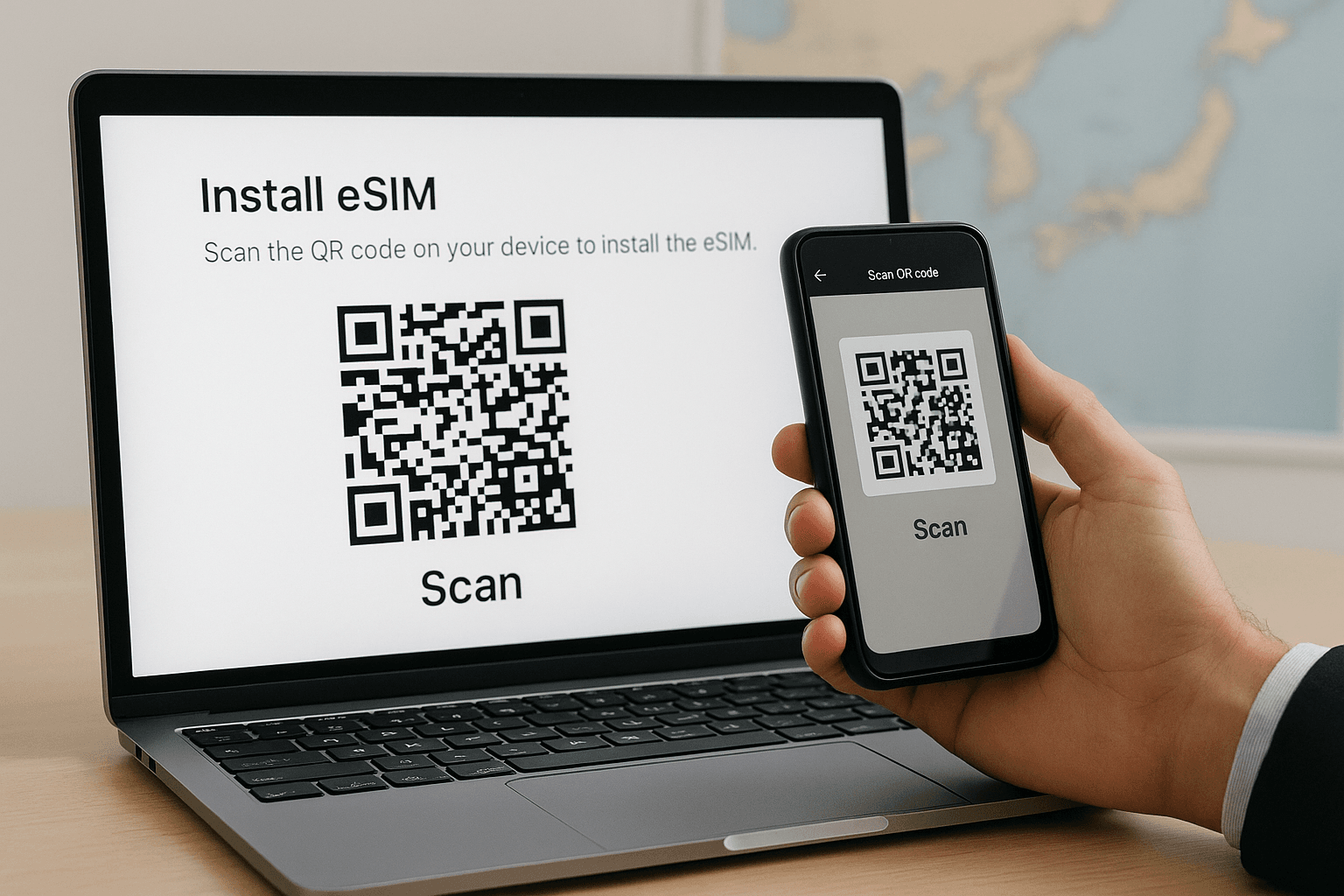
- After checkout, you’ll receive a QR code or activation link.
- On your phone, add a new mobile plan from your cellular settings and scan the code to install the profile.
- Label it clearly (for example, “CN-JP Business”) so you can quickly select it when you land in Tokyo and want the best esim for tokyo performance without confusion.
-
Set your preferred lines and data settings
- Keep your home SIM as the default for regular calls and critical SMS, like banking or two-factor codes.
- Set the new profile as your default data line, and enable roaming on that profile if required by the plan for cross-border use.
- This lets you control international business roaming costs while staying reachable on your usual number.
-
Test everything before departure
- Use Wi-Fi to download any necessary business apps or document libraries before your flight.
- Place a quick call or send messages using your preferred tools to confirm they function correctly on your new setup.
- If this is your first esim for china business travel and Japan trip combo, review your provider’s support guides so you know how to get help if anything goes wrong on the road.
Real-World Scenarios: From Beijing Boardrooms to Tokyo Tech Hubs
Once your setup is in place, it starts paying off in practical situations you face on every trip.
-
Sales leader bouncing between Beijing and Tokyo
You fly into Beijing for a regional strategy session, then head to Tokyo for client meetings. With your eSIM plan already active, you order a ride from the airport, open your calendar, and send your team an arrival update without thinking about local SIMs. When you land in Japan a few days later, your phone automatically connects to the right partner network and your schedule keeps flowing. -
Supply chain manager visiting factories and ports
You spend time far from city centers, touring facilities and shipping hubs. Reliable coverage in industrial areas matters more than fancy hotel Wi-Fi. A carefully chosen plan connected to strong networks in both countries keeps your messaging apps, translation tools, and document-sharing services working—even when you’re standing on a warehouse floor or at a port. -
Remote worker or consultant on a longer stay
You base yourself in one city for a few weeks but still take side trips to others. Because you’re working full-time from your laptop, you need consistent data for video calls and cloud tools. Instead of juggling local cards and multiple sign-ups, you rely on your preinstalled digital plan and hotspot when café Wi-Fi isn’t secure enough. -
Creator or corporate storyteller covering trade events
You document expos, summits, and product launches for your company or audience. You capture short-form video, share live impressions on social platforms, and upload edited clips at night. A business-friendly mobile setup gives you enough high-speed data to send content from crowded convention centers where everyone else is also trying to connect.
Across these scenarios, the pattern looks the same: when your device is ready to go in both countries, you spend less time troubleshooting connectivity and more time building relationships, closing deals, and capturing content that matters to your brand.
Pro Tips for Secure and Efficient Business Data Use
Good connectivity is only part of the story. As a professional traveler, you also need to protect your data, your accounts, and your company’s information.
-
Coordinate with your IT or security team
Before you travel, confirm which communication tools, cloud services, and security apps your company wants you to use in each region. Some popular platforms behave differently across borders, so align expectations ahead of time. -
Use secure connections for sensitive work
Avoid logging in to corporate tools or financial accounts on unknown public Wi-Fi, especially in busy hotels and airports. Your mobile plan gives you a more controlled environment, especially when you tether your laptop through your phone. -
Monitor your usage and performance
Keep an eye on your data consumption and adjust your habits if you’re nearing your limit. Many providers offer dashboards or usage alerts, which help you avoid mid-trip surprises. -
Download offline essentials
Save translation packs, key map areas, and critical documents for offline use. This ensures you can still access important information even during brief coverage gaps inside buildings, underground, or in remote areas. -
Stay informed about local norms and regulations
Check travel advisories and official guidance from trusted sources like your home government or major carriers’ international roaming guides before you leave. Rules and best practices can evolve, and staying informed helps you avoid issues.
FAQs: eSIM for China & Japan Business Travel
-
Will my company phone support a digital plan for both China and Japan?
Most recent flagship and many mid-range smartphones support digital plans on both iOS and Android, but you should confirm with your IT team and device specs. Make sure the phone is unlocked and can use the relevant bands in both countries. -
Can I keep my main number active while using a digital business plan abroad?
Yes. You can usually keep your primary line for calls and SMS while your additional profile handles data. This is ideal when you want colleagues and clients to reach you on your usual number without paying high roaming data rates. -
What happens if I run out of data mid-trip?
Most providers allow top-ups or add-ons, often from within an app or account portal. It’s smart to check those options before departure and know how to add more capacity if your week becomes busier than expected. -
Is it safe to rely on a digital SIM instead of a physical one?
For business travelers, a digital solution is often safer and more convenient because there’s no card to lose or damage. You can also add or remove plans in software if your travel pattern changes. -
What if I frequently travel beyond China and Japan?
In that case, look for regional or multi-country plans that align with your typical routes across Asia. Keeping everything in one place simplifies billing and reduces the complexity of managing separate accounts for every country.
Conclusion
When you treat connectivity as a core part of your travel planning—not an afterthought at the airport—you gain a smoother, more predictable experience across China and Japan, with fewer dropped calls, surprise charges, and lost hours. If you’re mapping out upcoming meetings in Beijing, Shanghai, Osaka, or Tokyo, you can review how Yoho Mobile works today and choose a plan that keeps your business running smoothly from your first takeoff to your final handshake.